
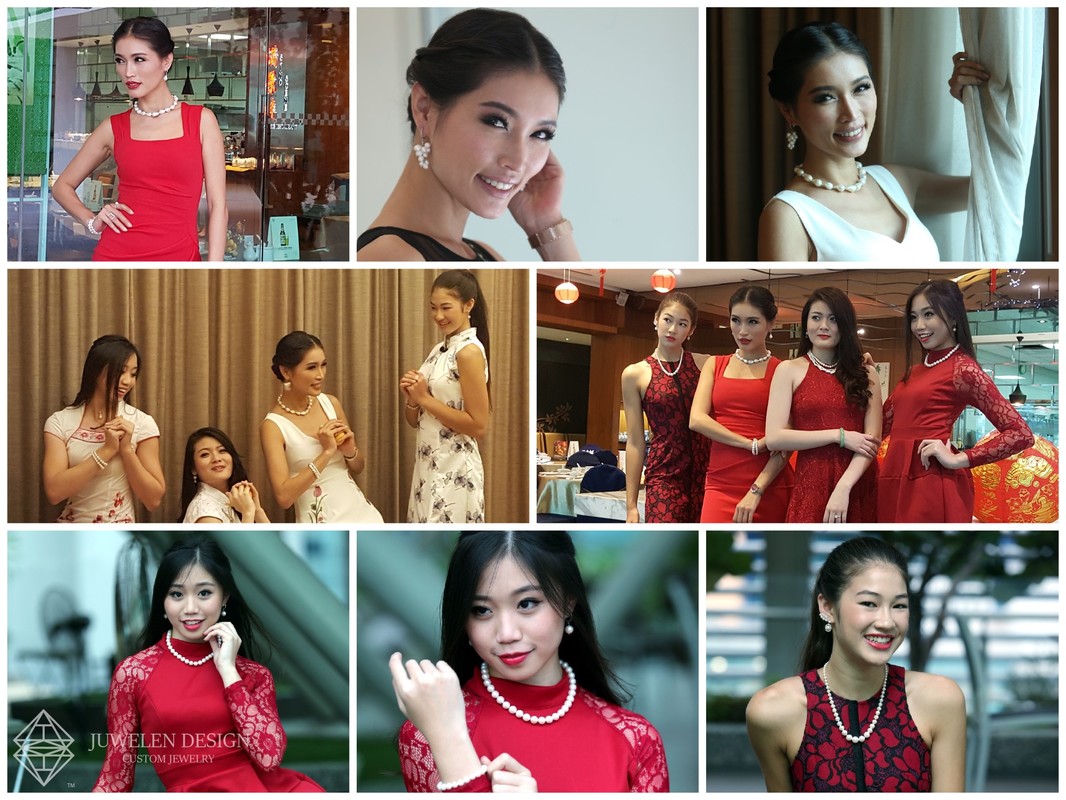
 Pearls reflect femininity at its most luminous that give a gloss, a certain refinement to the wearer. People can dazzle in diamonds, but it takes a certain type of woman to be a girl in pearls. No other gem is more lambent, or richly and resonantly symbolic of luxury, of beauty, of the paradoxes of femininity itself. An emblem of innocence and purity that has the swagger of the most knowing decadence, the pearl coruscates with magic and metaphor.
Pearls focus is on the intrinsic beauty of a miraculous natural phenomenon, the pearl itself. For the imaginative, pearls can be a metaphor – for the changing of an irritant into a thing of beauty and, by extension, how to turn a misfortune into something beneficial. Unlike other jewels, a pearl is a treasure grown inside a living creature that comes from the sea rather than being mined from the land. The reason for the luster and iridescence that are a pearl’s distinguishing features is the reflection of light through these layers, almost mirror-like. The layers of nacre of which a pearl is composed are absorbent, so that external factors can influence their condition and even color. Thus they improve with wear, picking up faint traces of oil from your skin that gives them an added gleam. So would you favor pearl necklace, pearl earrings, pearl bracelet or even pearl ring?
0 Comments
 Girls in pearls, Juwelen Design by Ivy Teong (Jewelry Designer) for 2017 Chinese New Year with Amber Chia, Malaysia's Top Model a.k.a. Brand Ambassador and other models in Berita Harian newspaper dated 1 Feb 2017. Pearl necklace, pearl bracelet, pearl earring, pearl ring are all for girls.
 Redesign Pearl Ring
Redesign allows you to preserve the sentiment of the original jewelry, while giving you a brand new design piece that you love today. We encourage you to make an appointment for your individual jewelry redesign session. Look at this pearl ring, does it look stunning?  Japanese Akoya Pearl Necklace
Cultured Japanese Akoya pearls are bead-nucleated cultured pearls produced from Akoya oyster Pinctada fucata martensii and Pinctada fucata chemnitzii. It is primarily found in Japan, China, Vietnam, South Korea and Australia. Akoya pearls are the specialty of Japanese pearl farms. It was first cultured pearls to be farmed using a bead and mantle tissue technique patented by Kokichi Mikimoto for Japanese Akoya pearl from Japan in 1916. It is the smallest pearl-producing oyster used in pearl culture today thus often found in the market in sizes from 3 to 10mm. They are also tend to be the most consistently round and near-round pearls making it adorned by many people. Japanese Akoya pearls with the ability of producing bright mirror-like luster are generally white or cream colored, with overtone colors of rose, silver and cream. Non-white colors such as blue, silver-blue and yellow exist but are considered uncommon colors.  Ruby that is not deemed red enough is actually considered a pink sapphire and not a Ruby. Ruby can contains secondary colors such as orange, purple, violet, and pink.
Ruby showing a very vivid crimson color would be deemed the most desirable but also very rare. Pigeon’s blood color is a vivid red color with high intensity and low tone without brown and orange overtones. That is why Pigeon Blood Ruby are considered so valuable. Traditionally, ruby was dominated by Pigeon Blood Ruby from Burma however, in recent years, Pigeon Blood Ruby has been found from Vietnam, Tajikistan, Afghanistan and Madagascar and very recently from Mozambique.  When mentioned about sapphire, blue is the all-time favourite color and the most classic choice. As color is the most important determinant, saturated hues that are neither too light nor too dark being the most valuable.
Royal Blue Sapphire is medium dark blue color in tone. Gems that have little or no gray or brown modifier are described as vivid. Royal Blue Sapphire with vivid saturation considered most valuable. Royal Blue Sapphire from Sri Lanka still considered most valuable compared to royal blue sapphire from rest of the world. Sapphire over 2 carats are rare and prices tend to increase exponentially with carat weight. Any high quality blue sapphire over 5 carats would be regarded as very rare and collectible.  Hanadama Japanese Akoya Pearls Necklace
“Hanadama” refers to the finest and highest quality Akoya cultured pearls in the world. It is also translated in Japanese as “Spherical Flower” and are also often called “Flower Pearls” in the trade. They have an extremely high luster due to their superiorly thick nacre, often the highest that an oyster can produce and near flawless surface. There are no standard international grading however these attributes are analyzed and certified to meet specific levels set by the Pearl Science Laboratory, Japan. They are the most trusted and strictest laboratory with set of standards published. Each Hanadama strand accompany with an authentication card or certificate with an authentic number from the Pearl Science Laboratory. In terms of the production they are also very rare and supply is very limited, as only 1 in every 500 AAA Akoya pearls qualifies as a Hanadama. Only a few Hanadama pearls are produced each harvest, making it far most valuable than any of AAA Akoya pearls. 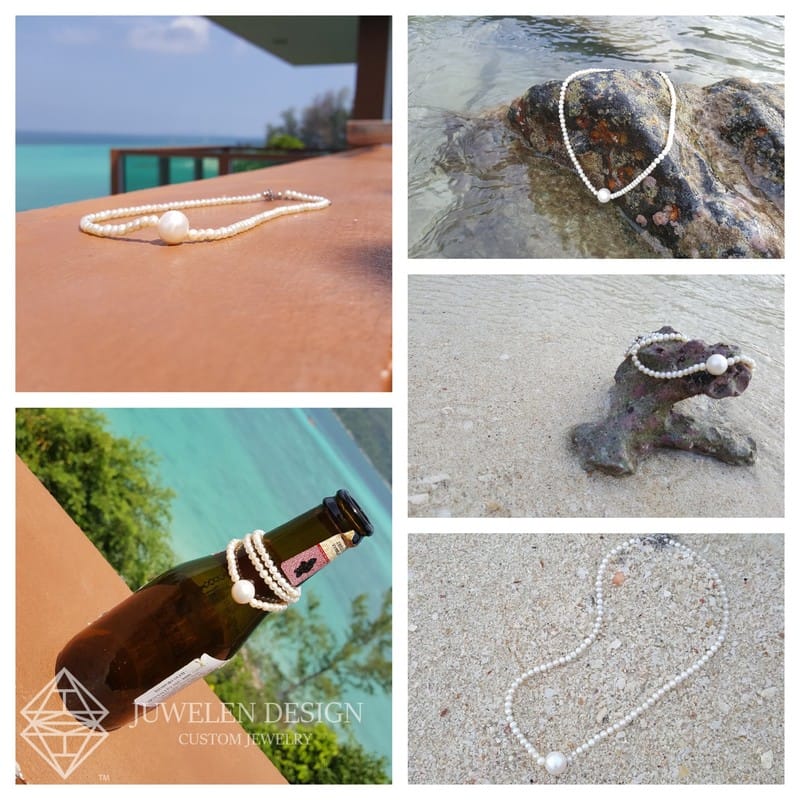 Pearls come from a living sea creature. Most pearls come from oysters either freshwater or saltwater environments.
As oysters grow, an internal organ called the mantle uses minerals from the oyster's food to produce a substance called nacre. Nacre is the material that forms the oyster's shell. When a foreign substance, such as a grain of sand, may find its way into the oyster and get stuck between the mantle and the shell. To protect itself, an oyster's natural reaction will be to cover up the irritant layer by layer of nacre. This substance, usually used to create the shell, will instead form a pearl.  Graduated Pearl Necklace
All graduated pearl necklaces can vary in size but a very common size starts with a central larger size pearl and graduates to a smaller size so the necklace flows evenly from small to large and back to small again. Truthfully, creating this type of necklace is labour intensive. It is much easier to match a uniform strand pearls rather than match a pearls progressively smaller along a necklace. In 1938 there were 360 active cultured pearl farms in Japan producing almost 11 million akoya cultured pearls. However, there were still limited quantities of Japanese akoya cultured pearls so creating uniform strands of pearls was close to impossible. So, the graduated strand of pearls was born. This marked an easy way to create a stylish pearl necklace that was not dependent on a full strand of identically sized pearls.  The gem quality Siamese ruby appears to be dark red to brownish red, sometimes have a slightly darker purplish shade of red but are cleaner stones overall having less rutile needle inclusions and more luster.
|
Author"Sharing is caring", by Ivy Teong, Chief Designer, Juwelen Design. She is also the author for juwelendesign.blogspot.my or ivyteong.blogspot.com 
Categories
All
|
Site powered by Weebly. Managed by Exabytes.my - Malaysia